
Revit Structure Families: Parametric Components & Framing Logic
Build structural content that won’t betray your takeoffs: predictable framing logic, clean constraints, and quantification-ready parameters. This is content systems training for working BIM teams.
Turn Structural Families Into a Reliable System.
By the End of This Course, You’ll Be Able To: ✅ Future-Proof Content: Adopt a parametric-first mindset to build structural families that adapt to changes without breaking. ✅ Data-Driven Documentation: Control schedules and takeoffs by aligning parameters with office and project standards. ✅ Scalable Systems: Move from one-off drafting to a repeatable framing and component system your team can trust. ✅ Error-Resistant Performance: Avoid common constraint and nesting issues that lead to bloated files and unreliable tags.
$499.00
Master a Repeatable Revit Family Creation Workflow
✓ Phase 1: The Setup (Why it Matters) Set the right category, reference planes, origins, and parameter strategy so families stay stable and scalable. ✓ Phase 2: The Build (How it Behaves) Model with clean constraints, formulas, visibility control, and (when needed) nested components—so families flex predictably without breaking. ✓ Phase 3: The Output (What you Deliver) Produce tag/schedule-ready families with consistent types, shared parameters, materials, and view- based graphics that stay reliable across views and sheets.
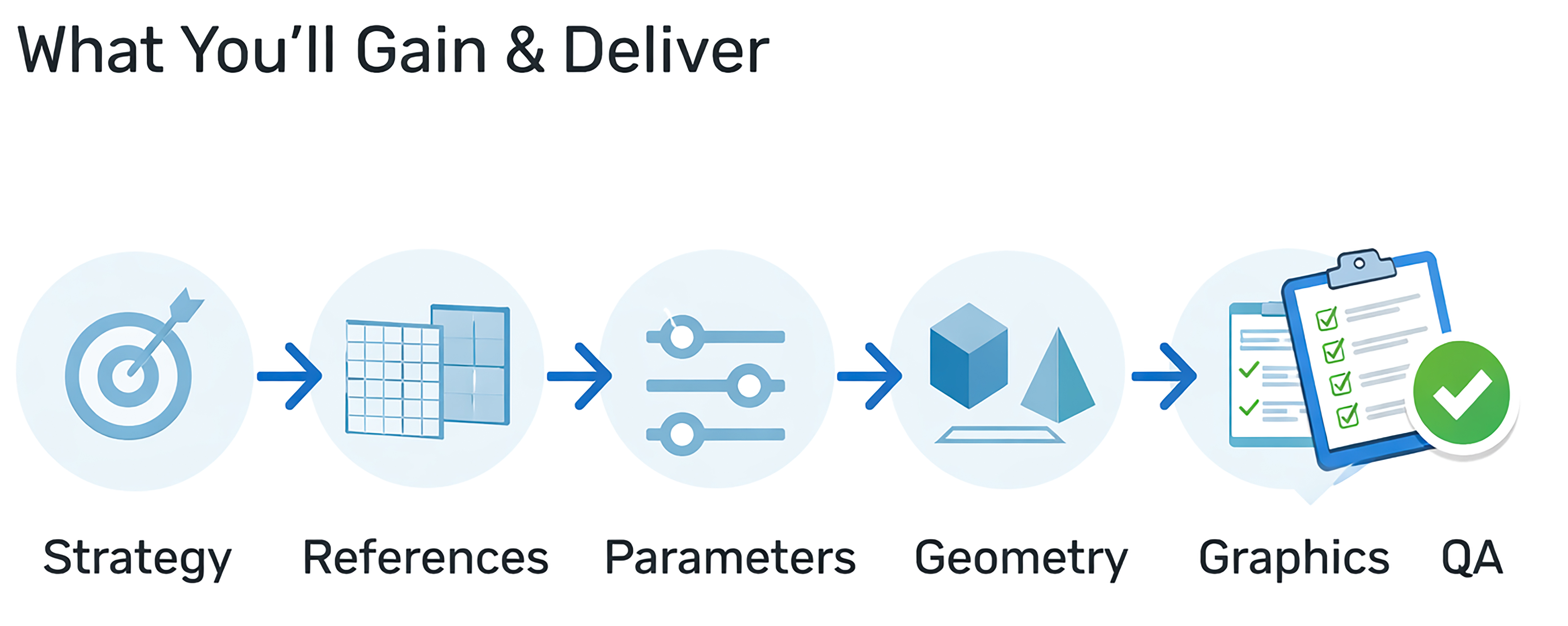
What You’ll Build: A Repeatable Revit Family Creation Workflow
You’ll stop guessing, fixing, and rebuilding families—and start creating stable, predictable, library-ready BIM content that performs reliably in real, coordinated projects. This course gives you a proven system to: • Build families that resize safely and behave predictably • Schedule and tag correctly—every time • Display cleanly in all views and detail levels • Follow one consistent standard your team can reuse No fragile families. No trial-and-error. Just a reliable workflow you can reuse on any project—every time.
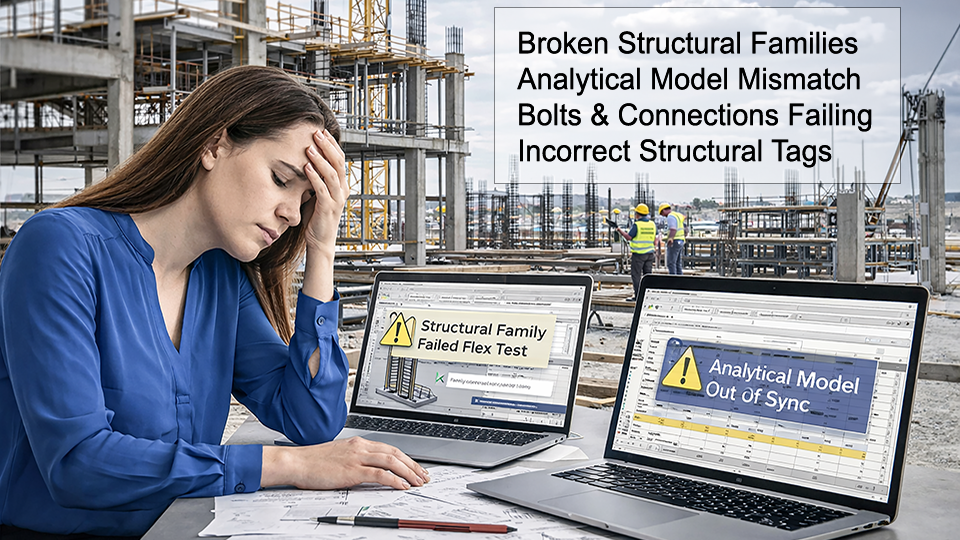
Ideal for BIM leads struggling with library consistency and broken framing families.
If any of these sound familiar, this course is built for you: 1.- Families break when you change types/sizes—or geometry shifts off alignment 2.- Tags and schedules don’t read correctly (type/instance data inconsistencies) 3.- Framing/column families won’t join or align cleanly across levels and grids 4.- Detail levels and views show inconsistent graphics (coarse/medium/fine issues) 5.- Your library grows fast—but standards, naming, and behavior stay inconsistent
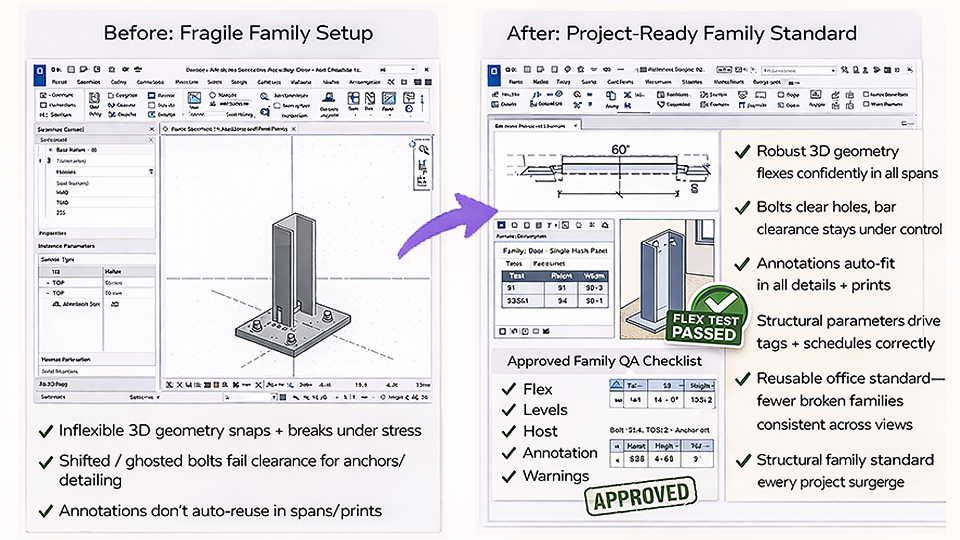
Move Beyond Rebuilding Structural Families. Trust Your Standards.
Stop wasting time troubleshooting broken geometry and start delivering precise models using a library built to withstand real-world design shifts. A validated workflow that produces stable, flex-safe structural families—clean geometry, reliable parameters, and consistent documentation across projects.
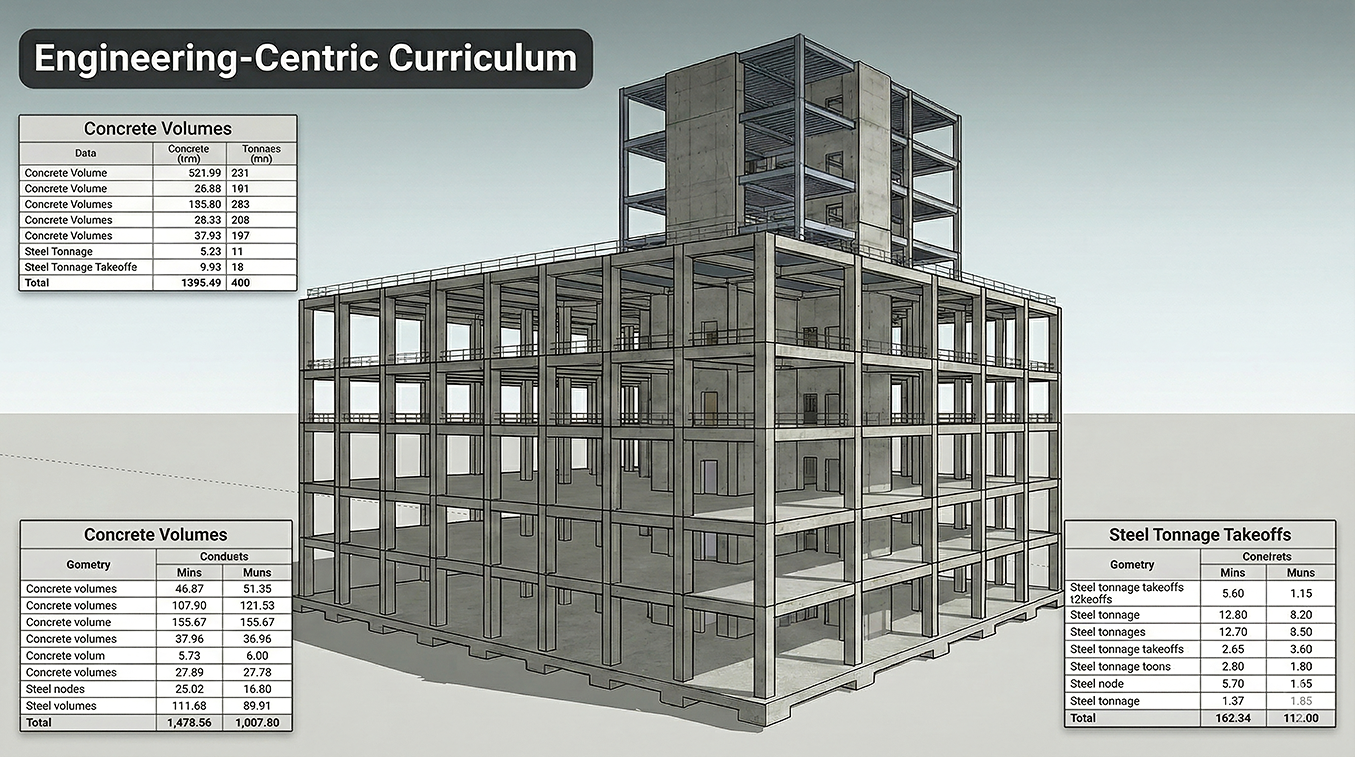
Predictable Structural Family Behavior
Move away from structural families that look correct but fail when dimensions, levels, or constraints change. Develop reference discipline, constraint strategy, and parameter logic so columns, beams, and foundations flex safely, align correctly, and remain stable under real project conditions.

Standardized Data, Tags & Schedules
Eliminate broken tags and unreliable schedules. Build structural families with clear type vs instance logic, shared parameters, and consistent data—ensuring quantities, tags, and schedules remain accurate across views, sheets, and revisions.
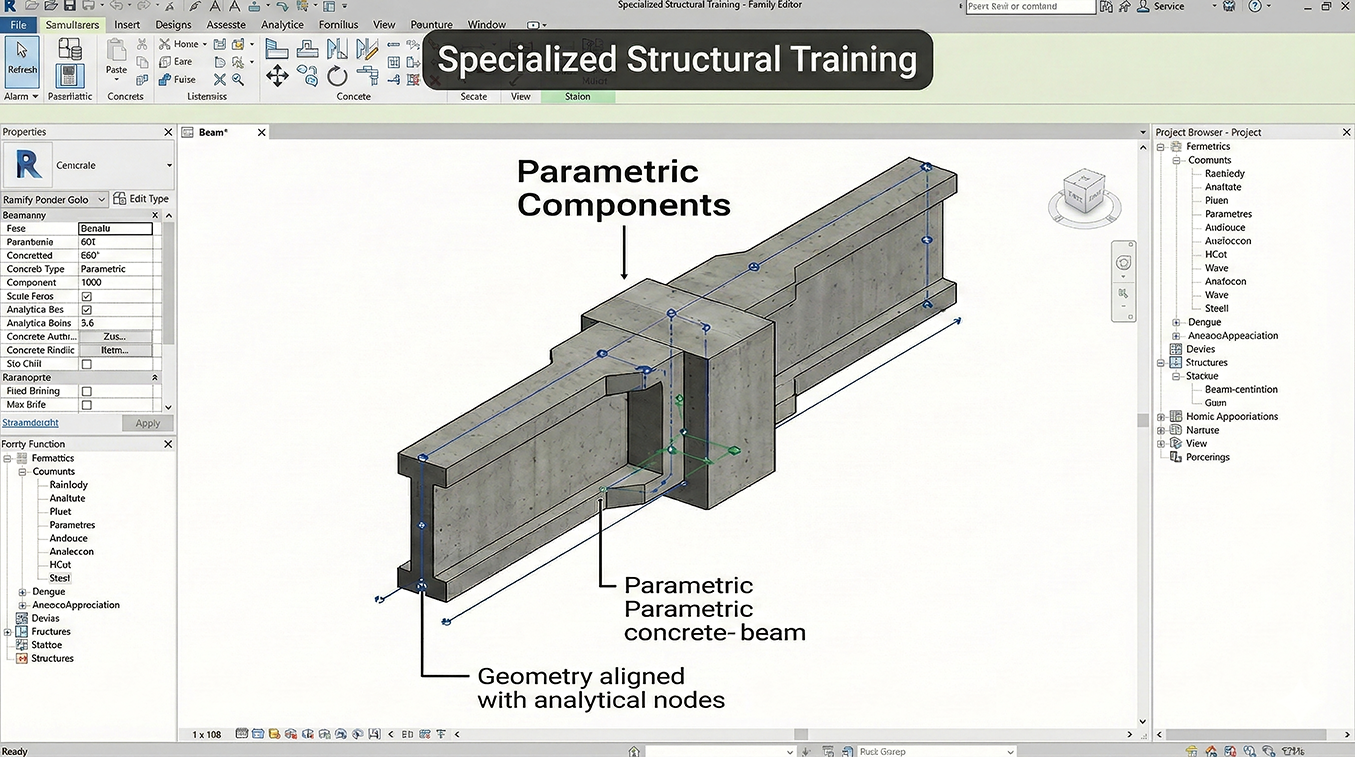
Clean Graphics Without Performance Loss
Move beyond bloated structural families and inconsistent detail. Create lightweight, documentation-ready families with clean symbolic representation, controlled visibility, and LOD-aware geometry—3D for coordination, 2D for sheets, without model slowdowns.
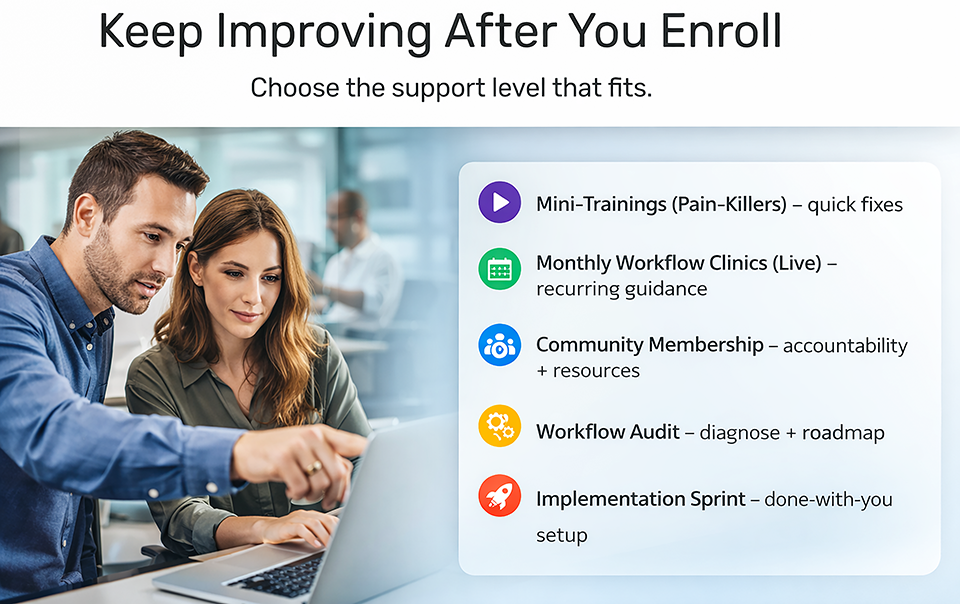
Support, when it matters.
You’re not on your own—choose the level of support you need to keep projects moving. Turn real project problems into repeatable workflows, with guidance when you need it. Coming after February 25th!
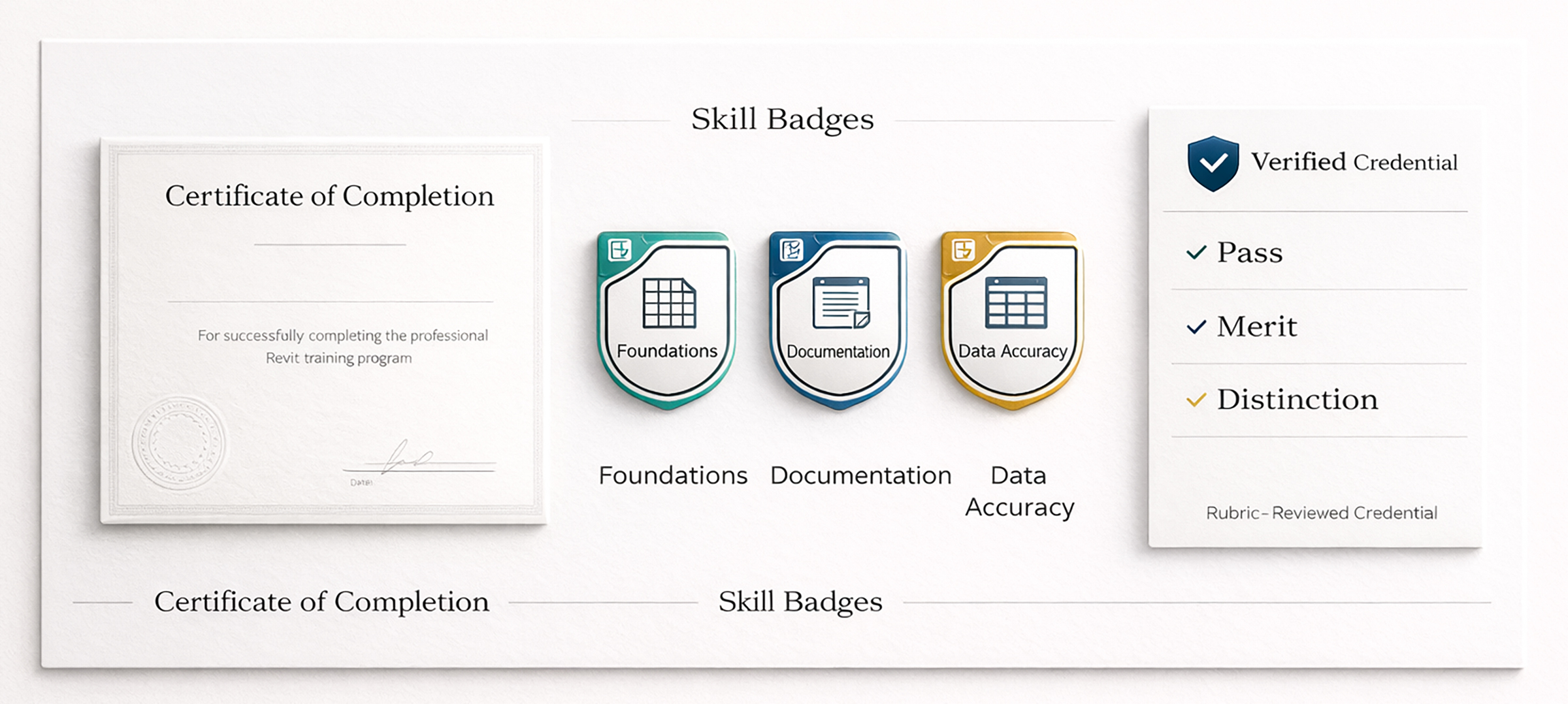
Revit Family Creation Credentials: Certificate, Skill Badges & Verified Credential
Included with enrollment: • Certificate of Completion • Shareable Skill Badges (earned when you submit the course capstone deliverable bundle) Optional Career Credential (Rubric-Reviewed): After you submit your capstone, you can request a Credential Review. You’ll complete a short Professional Readiness Upgrade on the same capstone (not a second project). Earn a Skills Verification Credential rated Pass / Merit / Distinction. Issued by Revit Strategies Academy (not an Autodesk certification). Credential Review availability: Credential Reviews are offered within monthly review capacity.

The Strategy Layer
✓ Workflow Decision Framework: The exact mental model for planning projects. ✓ Guided Practice Playbooks: Step-by-step PDF guides to build muscle memory. ✓ Validation Gates: Proof that your skills hold up under deadline pressure.

The Resource Vault
✓ Download Library: exercise files, checklists, and quick-reference PDFs ✓ Templates + Examples: starter view standards, sheet samples, schedule examples ✓ Resource Updates: new downloads added as the academy grows

The Support Network
✓ Learner Support: Q&A updates, clarifications, and resource guidance ✓ Community Access: connect with peers (if live) / coming soon (if not) ✓ Credentials Included: certificate + shareable skill badges
Master Revit Structure Family Creation for Reliable Documentation
Stop wrestling with constraint failures, misalignments, and tags that don’t behave. Build constraint-driven Revit Structure families that tag and schedule correctly, stay graphically clean, and hold up under real project pressure. Full course access includes Certificate of Completion, Skill Badges, and future course updates. Try Module 1 risk-free. If this workflow isn’t the right fit, email us within 7 days (and under 20% completion) for a full refund.
$499.00

Learn from an Autodesk Certified Instructor & BIM Strategist
I’ve spent 25+ years in the AEC industry, and one pattern shows up in every firm: structural family problems are rarely “modeling” issues—they’re constraint, standards, and parameter logic issues that break flexing, alignment, and documentation. I’m Roger Mujica, an Autodesk Certified Instructor (Silver) and BIM Strategist. I don’t just teach how to build families — I help professionals create production-ready structural Revit content with clean constraints, predictable flex behavior, and built-in validation—so tags and schedules stay accurate, graphics remain consistent across views, and families hold up across real projects without rework. You’ll learn the same structure professionals use to deliver under real deadlines—without rework. • Workflow-first project setup (levels, grids, coordinates, CAD links) • Documentation standards (views, sheets, schedules) • Real deliverables (not demos)
Proof from Real Revit Structure Family Workflows
See how production-ready structural families improved flex reliability, tagging accuracy, and consistency across views and sheets.
Our structural families looked fine until spans changed. Columns drifted, beams failed flex tests, and tags broke across views. This course gave us a clear method to control constraints and parameters so families flex safely and stay aligned. We finally trust our schedules and details again.
Lyon, France
Our library kept growing, but quality wasn’t improving. Families failed under real project pressure—especially with levels, joins, and detail views. This course introduced a repeatable QA process that made our structural content stable, reusable, and office-ready.
Zurich, Switzerland
I already knew how to model in Revit, but my families weren’t production-safe. After following Roger Mujica’s workflow, I stopped guessing and started validating. My families flex correctly, annotations stay consistent, and late design changes no longer cause rework.
Utrecht, Netherlands
What stood out in Roger Mujica’s training was the focus on behavior, not just geometry. I learned how to build structural families that align properly, flex predictably, and document cleanly across plans, sections, and sheets. That confidence completely changed how I work.
Madison, WI, USA
Our biggest issue was inconsistency. A family would work in one view and fail in another—misaligned geometry, broken tags, unreliable schedules. This course gave me a clear structure for constraints, parameters, and validation so my families behave the same everywhere.
Seville, Spain
We lost time fixing families during coordination and late-stage changes. After applying this workflow, our structural families flex correctly, maintain alignment across levels, and document cleanly without last-minute overrides. The difference in reliability is immediate.
Chicago, IL
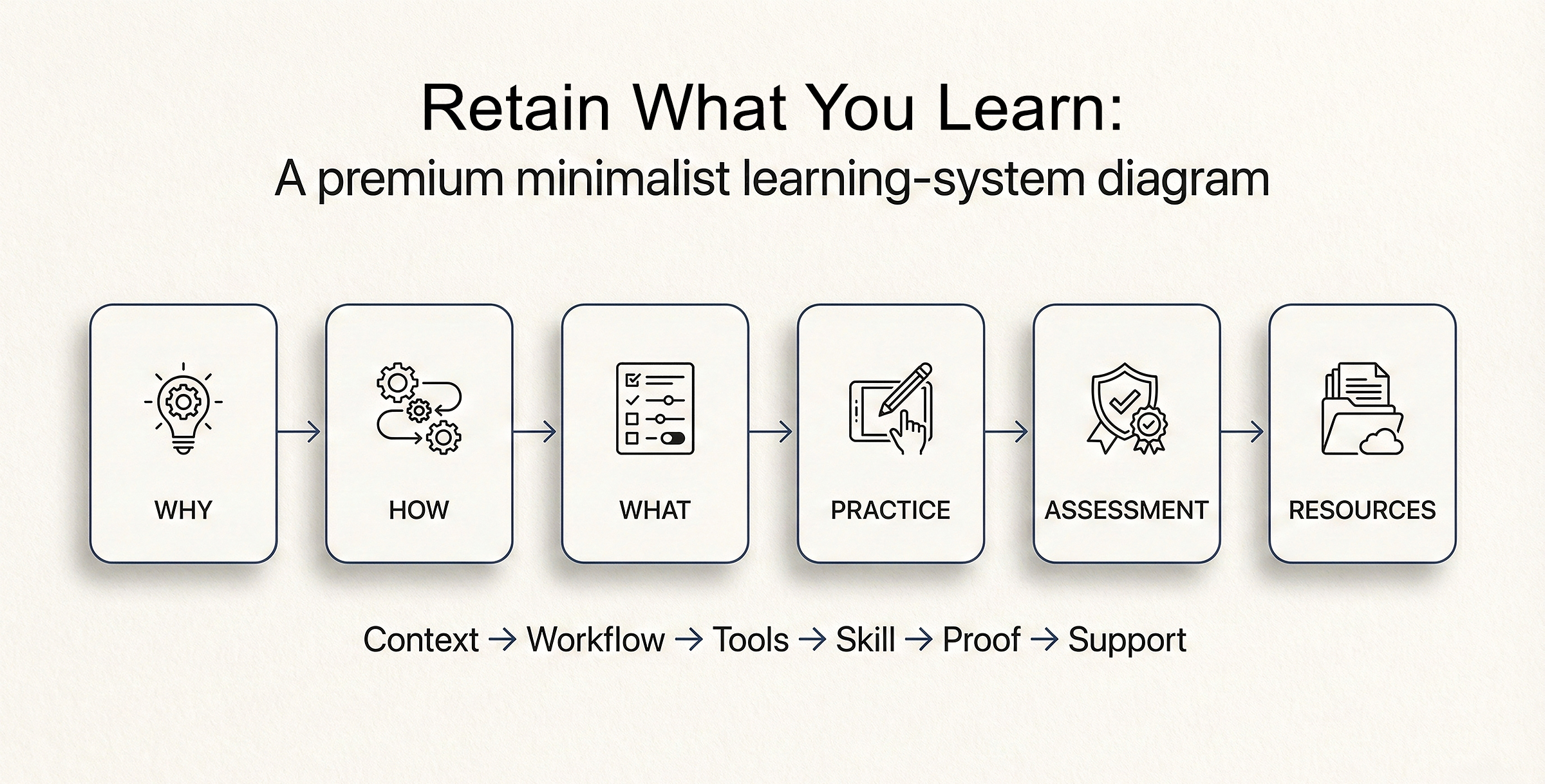
Revit Family Creation Workflow Training for Real Projects
Most courses overload you with “features” (the What) without context—so the knowledge doesn’t stick. This course uses a professional learning sequence built for real family creation delivery: ✓ Why: Strategy first—understand the problem we’re solving. ✓ How: Workflow in motion—see the sequence and how to build. ✓ What: Tools with context—settings only after the system is clear. ✓ Practice: Guided exercises that build repeatable skill. ✓ Assessment: Capstone checkpoints that prove competence. ✓ Resources: Templates and references to stay consistent on real projects. Not a tutorial library—a system for building professional Revit workflow capability.
Course Curriculum
-
-
(Included in full purchase)
Welcome: Course Roadmap & Outcomes (Video) — The “Why”
-
(Included in full purchase)
Workflow-First Learning: Build Skill Through Outcomes, Not Memorization (Reading) — The “Why”
-
(Included in full purchase)
Getting Started Checklist & Download Course Files (RVT/RFA/PDF) — The “How”
-
(Included in full purchase)
How to Use Thinkific (Navigation + Progress) (Video) — The “How”
-
(Included in full purchase)
Thinkific Quick Guide: Navigation + Progress
-
(Included in full purchase)
Course Files Explained (Pilot Project Concept) (Video) — The “What” | The “How”
-
(Included in full purchase)
Credentials & Proof of Skill: Certificate, Badges, and Career Credential (How You Earn Them) — The “What”
-
(Included in full purchase)
-
-
(Included in full purchase)
Module Overview: Goals + Roadmap
-
(Included in full purchase)
Why Structure Families Fail in Production - The “Why”
-
(Included in full purchase)
Family Strategy: System vs Loadable & The Editor Interface (Video) - The “What” - The “Why”
-
(Included in full purchase)
Family Categories, Hosting & Templates (Video) - The “How”
-
(Included in full purchase)
Family Environment Essentials: Reference Levels, Origin & Control Geometry - The “What”
-
(Included in full purchase)
Core Practice: Open, Inspect & Diagnose a Family - The “Practice”
-
(Included in full purchase)
Checkpoint: Family Editor Fundamentals Review - The “Assessment”
-
(Included in full purchase)
Templates & Standards: Naming, Categories & Best Practices - The “What”
-
(Included in full purchase)
Reading — Cheat Sheet: The "Which Template?" Picker & Naming Standard - The “Resource”
-
(Included in full purchase)
Reading — Geometry Mistakes That Break Families Early - The “Resource”
-
(Included in full purchase)
-
-
(Included in full purchase)
Module Overview: Goals + Roadmap
-
(Included in full purchase)
Why the Interface Changes: Category & Discipline Context — The “Why”
-
(Included in full purchase)
Mastering the Ribbon: Forms, Datum & Work Planes (Video) — The “How”
-
(Included in full purchase)
The Family Types Manager: The Brain of the Family (Video) — The “What”
-
(Included in full purchase)
Type vs. Instance Parameters: Understanding the Default Suffix — The “What”
-
(Included in full purchase)
Environment Essentials: Object Styles & Project Units — The “How”
-
(Included in full purchase)
Core Practice: Interface Scavenger Hunt & Setup — The “Practice”
-
(Included in full purchase)
Checkpoint: Family Editor Interface Proficiency — The “Assessment”
-
(Included in full purchase)
Reading — Comparison Map: Priority Tools by Discipline — The “Resource”
-
(Included in full purchase)
-
-
(Included in full purchase)
Module Overview: Goals + Roadmap
-
(Included in full purchase)
The Parametric Skeleton: Why Families Break Without It - The “Why”
-
(Included in full purchase)
Building the Skeleton: Reference Planes & Work Planes (Video) - The “How”
-
(Included in full purchase)
Constraints That Behave: Align/Lock, Dimensions, Equality & Safe Relationships (Video) - The “How”
-
(Included in full purchase)
Core Practice A: Build a Skeleton Framework for a Simple Component - The “Practice”
-
(Included in full purchase)
Flex Before You Model: The “Skeleton-First” Workflow (Video) - The “What”
-
(Included in full purchase)
Core Practice B: Use Parameters to Control & Flex a Casework Shell - The “Practice”
-
(Included in full purchase)
Checkpoint: Flex-Proofing the Framework - The “Assessment”
-
(Included in full purchase)
-
-
(Included in full purchase)
Module Overview: Goals + Roadmap
-
(Included in full purchase)
Why Parameters & Data Logic Matter More Than Geometry - The “Why”
-
(Included in full purchase)
Type vs Instance Parameters (Video) - The “How”
-
(Included in full purchase)
Data Logic: Controlling Behavior Parameters (Video) - The “Why” - The “How”
-
(Included in full purchase)
Yes/No Parameters & Visibility Control (Video) - The “What” - The “How”
-
(Included in full purchase)
Core Practice: Build a Configurable Cabinet / Fixture Family - The “Practice”
-
(Included in full purchase)
Checkpoint: Smart Family Behavior Test - The “Assessment”
-
(Included in full purchase)
Reading — Shared Parameters: Tagging & Consistency - The “Resource”
-
(Included in full purchase)
-
-
(Included in full purchase)
Module Overview: Goals + Roadmap
-
(Included in full purchase)
Geometry Fundamentals: Understanding Solids - Voids & Why Clean Geometry Matters - The “Why”
-
(Included in full purchase)
Solid Modeling I: Extrusions & Blends (Video) - The “How”
-
(Included in full purchase)
Core Practice I: Build a Tapered Table Leg (Blend) - The “Practice”
-
(Included in full purchase)
Solid Modeling II: Revolves, Sweeps & Swept Blends (Video) - The “How”
-
(Included in full purchase)
Core Practice II: Build a Decorative Baluster (Revolve) - The “Practice”
-
(Included in full purchase)
Void Forms: Cutting Geometry Correctly (Video) - The “What”- The “How”
-
(Included in full purchase)
Core Practice III: Build a Custom Rainwater Collection Box (using Voids) - The “Practice”
-
(Included in full purchase)
Checkpoint: Geometry Logic Validation - The “Assessment”
-
(Included in full purchase)
-
-
(Included in full purchase)
Module Overview: Goals + Roadmap
-
(Included in full purchase)
Why Constraints & Rules Matter in Production - The “Why”
-
(Included in full purchase)
Formula & Constraints Fundamentals (Video) - The “How”
-
(Included in full purchase)
Conditional Logic & Safe Combinations - The “What”
-
(Included in full purchase)
Core Practice: Build a Rule-Driven Family - The “Practice”
-
(Included in full purchase)
Checkpoint: Behavioral Logic Test - The “Assessment”
-
(Included in full purchase)
Reading — Formula Debugging Guide - The “Resource”
-
(Included in full purchase)
-
-
(Included in full purchase)
Module Overview: Goals + Roadmap
-
(Included in full purchase)
Structural Behavior in Revit: What Makes a Family “Structural” - The “Why”
-
(Included in full purchase)
Analytical Model Basics (Intro): Why Engineers Care - The “What”
-
(Included in full purchase)
Analytical Modeling: Alignment & Stability Workflow (Video) - The “How”
-
(Included in full purchase)
Connection Readiness: Member Control & End Clearances - The “What”
-
(Included in full purchase)
Reference Line / Member Control: Framing Placement That Behaves (Video) - The “How”
-
(Included in full purchase)
Connection-Ready Ends: End Planes, Clear Zones & Cut Intent (Video) - The “How”
-
(Included in full purchase)
Core Practice: Make the Capstone “Analysis + Connection Ready” - The “Practice”
-
(Included in full purchase)
Checkpoint: Structural Readiness Test - The “Assessment”
-
(Included in full purchase)
-
-
(Included in full purchase)
Module Overview: Goals + Roadmap
-
(Included in full purchase)
Overview: Structural Placement & Joining Logic - The “Why”
-
(Included in full purchase)
Placement Rules: Insertion Points & Work Planes (Video) - The “How”
-
(Included in full purchase)
Join & Cut Behavior for Structural Elements (Video) - The “How”
-
(Included in full purchase)
Reading — Reference Guide: The Structural Behavior Matrix - The “What” - The “Resource”
-
(Included in full purchase)
Core Practice: Load, Place & Validate Foundation Family - The “Practice”
-
(Included in full purchase)
Checkpoint: Placement & Stability - The “Assessment”
-
(Included in full purchase)
-
-
(Included in full purchase)
Module Overview: Goals + Roadmap
-
(Included in full purchase)
Why LOD & Visibility Matter - The “Why”
-
(Included in full purchase)
Visibility by View + Coarse / Medium / Fine (Video) - The “How”
-
(Included in full purchase)
Symbolic Lines & Masking Regions (Video) - The “What” - The “How”
-
(Included in full purchase)
Core Practice: Create a View-Clean Family - The “Practice”
-
(Included in full purchase)
Checkpoint: Graphics & LOD Review - The “Assessment”
-
(Included in full purchase)
-
-
(Included in full purchase)
Module Overview: Goals + Roadmap
-
(Included in full purchase)
Why Quality Assurance Is the Real Skill - The “Why”
-
(Included in full purchase)
Testing Families in Real Projects (Video) - The “How”
-
(Included in full purchase)
QA Checklist: Host, Cut, Schedule, Tag, LOD, Warnings - The “What”
-
(Included in full purchase)
Core Practice: Full Family QA Pass - The “Practice”
-
(Included in full purchase)
Final Checkpoint: Library-Ready Family Validation - The “Assessment”
-
(Included in full purchase)
-
-
(Included in full purchase)
Common Family Failures & Fixes - The “Resource”
-
(Included in full purchase)
Family Naming & Library Organization Guide - The “Resource”
-
(Included in full purchase)
30-Day Practice Plan - The “Capstone Practice”
-
(Included in full purchase)
The Roadmap Ahead: Recommended Next Courses — The “Strategy”
-
(Included in full purchase)
✓ Course Access & Release Schedule ✓ Start with the core now—new modules release in Waves (included).
This course is released as a progressive learning system designed for real project delivery. Each Wave builds workflow clarity, sequencing, and validation — the same logic professional firms rely on to keep models stable under deadline pressure. With enrollment, you start with the core foundations now and receive future Waves as they’re released—so your workflows keep getting stronger over time.

🔵 Wave 1 — Foundations Core (Start Here)
✔ Available immediately after enrollment. Structural Family Editor essentials: reference planes, constraints, parameters, and category-specific behavior—build your first production-ready structural families (columns, beams, foundations, framing components) with correct hosting logic, alignment control, analytical awareness, and clean, predictable behavior for real projects.
🟠 Wave 2 — Production Workflows
✔ Released progressively after launch. Structural-ready standards: clear type vs instance strategy, shared parameters for tags and schedules, visibility and detail-level control, nested components, materials and subcategories, and documentation outputs that remain consistent across plans, sections, schedules, and sheets—even as models grow and change.

🟣 Wave 3 — Mastery & Validation
✔ Released progressively after launch. QA + performance systems: structural family testing checklists, formula logic, robust flexing strategies, clean geometry and alignment control, standards planning, advanced behaviors (yes/no options, conditional visibility), coordination-safe updates, and reliable reuse across projects and offices.
The Pilot Project System
Don’t guess how structural families should behave. Build production-ready columns, beams, foundations, and framing content with a guided pilot workflow—from reference control and constraints to parameters, tagging, and validation—so families flex safely, align correctly, and document reliably in real projects.

Flex-Testing Validation Gates
Every module ends with a validation checkpoint. You test constraints, flex behavior, alignment, parameters, and visibility before moving on—so structural families don’t break across spans, levels, views, or late-stage design changes.

The Revit 2025 Toolkit
A “Structural Family-in-a-Box” download with structural templates, parameter standards, visibility/graphics rules, QA checklists, and proven reference setups—so your content stays consistent across projects, teams, and offices.
Start Building Office-Standard Revit Structure Families Today
Start now with the Foundations Core. New Waves release progressively—included with your enrollment. What You Get: ✅ Lifetime access to all course modules (including future Waves as they’re released) ✅ The Revit Toolkit (Updated for 2025): templates + view standards + QA checklists ✅ Certificate of Completion + shareable Skill Badges 7-Day Money-Back Guarantee Explore Module 1 risk-free. If it’s not the right fit, email us within 7 days (and under 20% completion) for a full refund.
$499.00